MENU
TH EN

4. Brahmāṇḍa Purāṇa 1

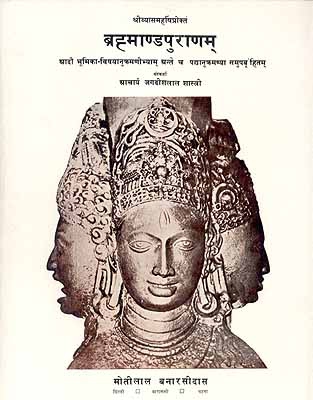
Hero Image & Title Thumbnail: Book Cover of Brahmāṇḍa Purāṇa (Sanskrit Only), source: www.exoticindiaart.com, access date: Apr.2, 2026.  
4. Brahmāṇḍa Purāṇa 1
First revision: Apr.2, 2026
Last change: Apr.3, 2026
Searched, gathered, rearranged, translated, and compiled by Apirak Kanchanakongkha.
1.
Page 9
 
Pūrva01 Bhaga02 (The first part)

Chapter 1-1(1) (Preliminaries to the Purāṇa)1

I prostrate myself before the one who is full of sattva03 at the time of creation, preservation and destruction. I bow down. Furthermore, I prostrate myself before Svayambhū04, who has the three forms of sattva, rajas, and tamas.2 The victorious Bhagavān Hari05 holds up the worlds. He is Aja and the universe is his form. He is Nirguṇa06, but the guṇas exist in his atman. Brahmā is the creator of the worlds. He is omniscient and unvanquished. He is the lord of the past, the present and the future. Right now, he is the virtuous lord. The lord of the universe possesses unmatched Jñāna,07 non-attachment, powers and dharma.3 The virtuous should serve these four objectives. Within them, humans constantly possess virtuous and wicked sentiments. Understanding these sentiments, without hesitation,
---------------

1. There are several typos and inconsistencies in this introductory chapter.
2. Svayambhū means the one who is his own origin. It is applied to each of Brahmā, Viṣṇu and Śiva. Here, it is clearly addressed to Viṣṇu. Sattva, rajas and tamas are the three respective guṇas of purity, passion and darkness/ignorance. Aja means someone who is devoid of birth and Nirguna means someone who is devoid of guṇas.
3. Jñāna is knowledge. The words Jñāna and Vijñāna
08 are often used synonymously, and both words mean knowledge. When distinct meanings are intended, Jñāna signifies knowledge obtained from texts and gurus, while Vijñāna signifies knowledge obtained through inward contemplation and self-realization.     
Notes & Narratives:
01. Pūrva (पूर्व) - Previous to, earlier than, Old, ancient.
02. Bhaga (
भग) - General.
03. Sattva (सत्त्व) - One of the three guṇas.
04. Svayambhū 
(स्वयम्भू
) is a term meaning "self-born," "self-manifested," or "existing by its own accord". In Hindu and Buddhist traditions, it describes deities, entities, or sacred objects (like Liṅgas - लिङ्ग - The symbol of Śiva) that are not created or installed by human hands but are of natural, divine origin. It represents the self-existent nature of the divine.
05. Bhagavān Hari - a primary name for Lord Viṣṇu in Hinduism, representing the supreme protector and preserver of the universe who removes darkness, sins, and illusions. As a central deity in Vaiṣṇavism, Hari is revered as the compassionate, all-pervasive Lord who incarnates to restore cosmic order.
06. Nirguṇa (निर्गुण) - 1) “attributeless” is used to describe Śiva 2) One of the 108 names of Krishna; Meaning: "Without Any Properties."
07. Jñāna (ज्ञान - knowledge).
08. Vijñāna (विज्ञान) - true knowledge, consciousness, specific knowledge or understanding.

1.
2.
Page 10
Īśvara01 repeatedly engages them in Kriyā.1 The creator of the world knows about the truth. He knows yoga and has restored to yoga.
---------------

1. Kriyā (क्रिया) - Deeds or rites.
Notes & Narratives:
01. Īśvara (ईश्वर) is used as an epithet for Śiva, according to the Śiva Purāṇa 2.2.41.
   
1.
2.
3.
4.
5.
humanexcellence.thailand@gmail.com