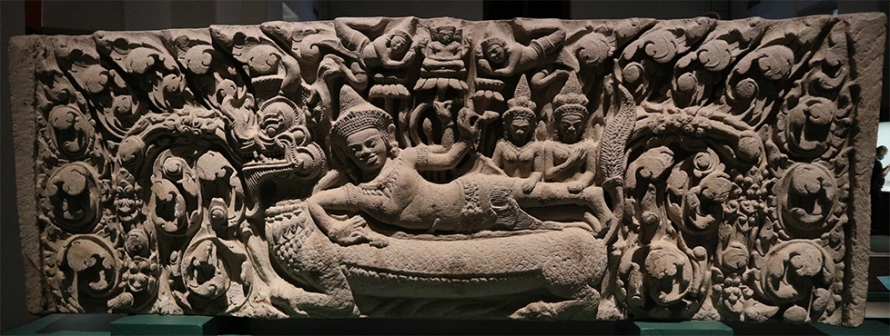
Title Thumbnail & Hero Image: Viṣṇu reclining on the serpent Shesha (Ananta Shesha) in Cosmic Ocean Lintel, a sandstone, Lopburi art (Khom art in the territory of Thailand), carved around the 11-12th century A.D.(800 years ago), originally located at Prang Ku Suan Taeng, Subdistrict. Nong Waeng, Phutthaisong District, Buriram Province. It was stolen by a criminal on April 15, 1964, and smuggled to the United States for sale. Mr. Avelry Rander later returned it to the Fine Arts Department on July 25, 1970. It is currently enshrined at the National Museum of Bangkok, Bangkok, Thailand, taken on November 14, 2021.
Viṣṇu Purāṇa 1
First revision: May 30, 2024
Last change: May 21, 2026
Searched, gathered, rearranged, translated, and compiled by Apirak Kanchanakongkha.
1
xiii
Introduction
1.
The word "Purāṇa" (पुराण) means 'old' or 'ancient'. The Purāṇas are ancient scriptures, often grouped with the Itihāsa01 (Rāmāyaṇa and Mahābhārata).1 Whether the Itihāsa originally referred only to the Mahābhārata, with the Rāmāyaṇa added to that version later, is a subject of some debate. But that's not our purpose at all. In the Chāndogya Upaniṣad (छान्दोग्योपनिषद्), it is mentioned that the Sage Ṛṣi Nārada (see details in the explanatory note on page 1 of 01. Bālakāṇḍa, Rāmāyaṇa) visits Sanātkumāra02. To teach. When the sage inquired, he learned that Sanātkumāra already knew. Sage Ṛṣi Nārada said that he knew of the Itihāsa and Purāṇa, the fifth Veda.2 In other words, the Itihāsa and Purāṇa have a high status. This does not mean that the word 'Purāṇa' as used in these two Upaniṣads and other texts must be understood in the same sense as the word used for the collection of texts called Purāṇas today. The Rāmāyaṇa is believed to have been composed by the great sage Vālmīki (वाल्मीकि), and the Mahābhārata by the great sage Kṛṣṇa Dvaipāyana Vyāsa (कृष्ण द्वैपायन व्यास). It is also believed that the sage Vyāsa composed the Purāṇas at a later time. The use of the word ‘composed’ or ‘authored’ indicates that the Itihāsa-Purāṇas are Smṛti scriptures, originating from humans, not Śruti scriptures, which originate from God.
---------------
1. For example, ślokas (verses) 2.4.10, 4.1.2, and 4.5.11 of the Bṛhad-āraṇyaka Upaniṣad (बृहदारण्यक उपनिषद्) use both versions together.
2. छान्दोग्योपनिषद् - Chāndogya Upaniṣad, 7.1.2.
Notes and Narratives:
01. Itihāsa (इतिहास) - "History" or "the traditional narrative of past events" can also mean "thus it happened."
 The four Kumāras (Sanaka, Sanandana, Sanatana, & Sanātkumāra), source: gloria.org, accessed May 30, 2024.
1.
02. Sanātkumāra (सनत्कुमार - eternal youth) - One of the Four Young Masters {Sanaka (सनक), Sanandana (सनन्दन), Sanātana (सनातन), and Sanātkumāra (सनत्कुमार)}, the four wise young masters according to the Purāṇas. All four are sons born from the mind of Brahma, or the spiritual sons of Brahma. The four young masters vowed to remain celibate for life and studied the Vedas together. All four young masters play important roles in the worship of Viṣṇu and Kṛṣṇa. And it appears in the Mahābhārata, in the Udyōga Parva, Upaparva: Sanatsujāta (सनत्सुजात).
1.
2.
xiv
The term "compilation" here does not mean that these messages were recorded in writing, but rather that they were transmitted orally (มุขปาฐะ - oral tradition), which inevitably involved noise and interference during the transmission and dissemination process. Writing came much later.
Pargiter's book on the Purāṇas remains one of the best introductions to the Viṣṇu Purāṇa.1 In explaining the process of its composition and transmission, there is no better place to refer to his own words.
The Vāyu and Padma Purāṇas tell us how ancient genealogies, tales, and ballads were preserved, namely, by the sūtas,2 and they describe the sūta’s duty … The Vāyu, Brahmaṇa, and Viṣṇu give an account of how the original Purāṇa came into existence … Those three Purāṇas say - Kṛṣṇa Dvaipāyana divided the single Veda into four and arranged them, and so was called Vyāsa. He entrusted them to his four disciples, one to each, namely Paila (पैल), Vaisampayana, Jaimini, and Sumantu. Then with tales, anecdotes, songs, and lore that had come down from the ages, he compiled a Purāṇa and taught it and the Itihāsa to his fifth disciple, the sūta Romaharṣaṇa or Lomaharṣaṇa (रोमहर्षण - Loma = hair, Haryana = thrill) … After that, he composed the Mahābhārata. The epic itself implies that the Purāṇa preceded it… As explained above, the sūtas had from remote times preserved the genealogies of gods, ṛṣis, and kings, and traditions and ballads about celebrated men, that is, exactly the material – tales, songs, and ancient lore – out of which the Purāṇa was constructed. Whether or not Vyāsa composed the original Purāṇa or superintended its compilation, is immaterial for the present purpose… After the original Purāṇa was composed by Vyāsa, as it is said, his disciple Romaharṣaṇa taught it to his son Ugraśravas,
---------------
1. Ancient Indian Historical Tradition, F.E. Pargiter, Oxford University Press, London, 1992.
2. Śūtas were bards, minstrels, and raconteurs.
 Lord Viṣṇu, developed on Jul.16, 2024 & adjusted on Apr.28, 2025
xv
and Ugraśravas, the sauti (सौति) appears as the reciter in some of the present Purāṇas; and the sūtas still retained the right to recite it for their livelihood. But, as stated above, Romaharṣaṇa taught it to his six disciples, at least five of whom were brahmans, and their appropriation and development of it increased in the course of time, as the Purāṇa grew into many Purāṇas, as Sanskrit learning became peculiarly the province of the brahmans, and as new and frankly sectarian Purāṇas were composed.
1
1.

The Brahmin is composing the Manu Smṛti—source: templepurohit.com, accessed December 27, 2025.
2.
3.